The Moldova variety is a table grape variety - broadly disease resistant.
Created through interspecific hybridisation of the varieties Guzal Kara and Seyve Villard 12375 at the Chisinau Institute of Viticulture and Winemaking.
It is a mid-ripening or late-ripening variety (depending on the conditions in which it is grown). Ripens around 15-25 September. In some more northern regions and at higher altitudes it may fail to ripen fully in certain years.
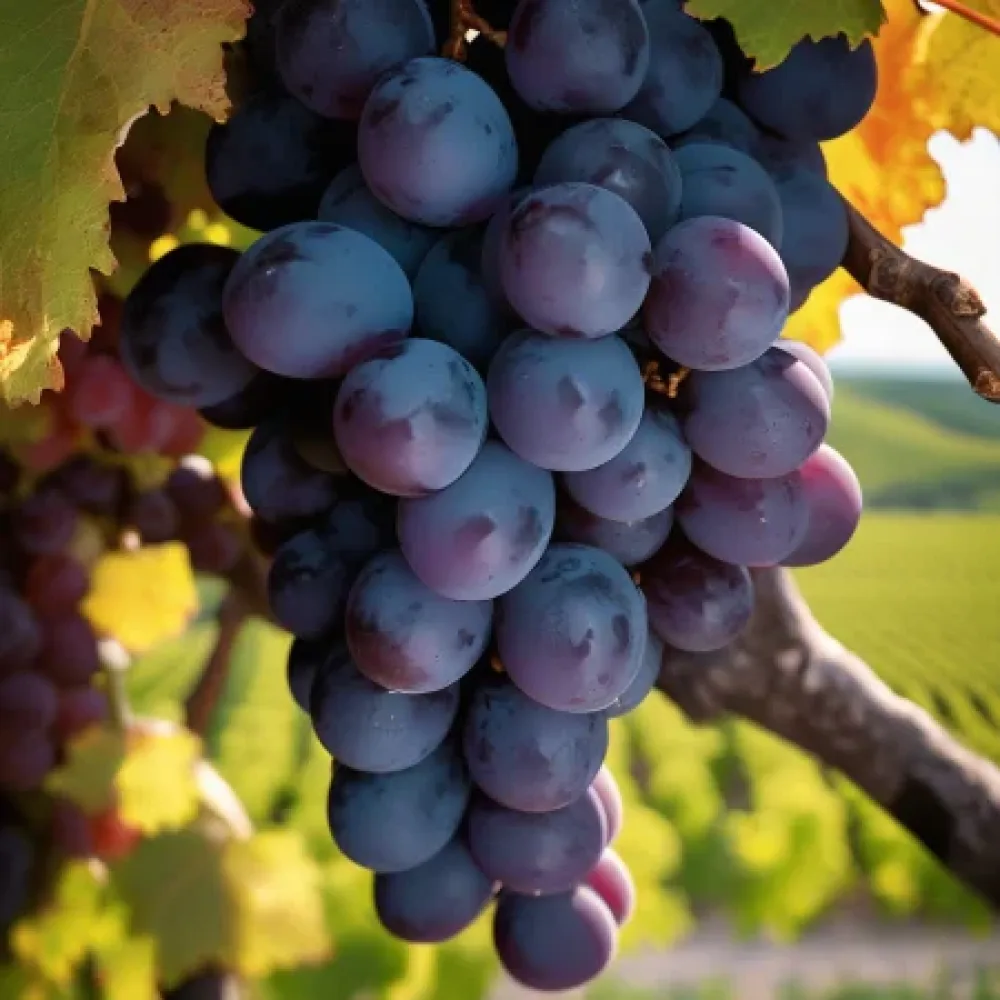
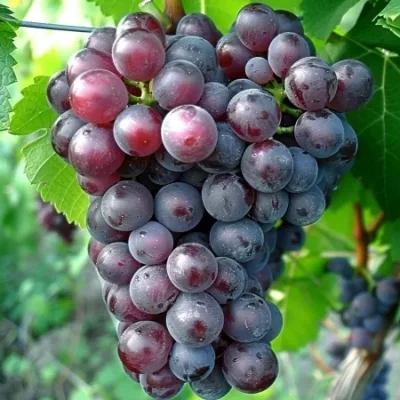
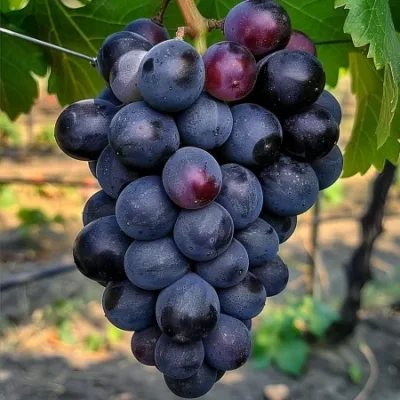
The leaves are medium-sized, slightly cut, almost entire, 3-5-lobed. The flower is hermaphrodite, the bunch cylindrical-conical or conical, moderately compact, medium-sized. The average weight of 1 bunch is 385g. Individual bunches can reach a weight of up to 1 kg. Berry - large (25/19mm), egg-shaped, dark violet, with a dense waxy bloom. The skin is usually thick, firm, strong and intensely coloured (a characteristic feature of the variety). The fleshy part is crunchy. The taste is neutral. Growth is vigorous; it does not tolerate crowding. Moldova vines are vigorous, so care must be taken when choosing the planting scheme. Crowding is unacceptable for it, since in that case poor fruit set is observed and, accordingly, a reduction in yield. The bunches become loose and relatively small. High-trunk and pergola-style training systems with free arrangement of the growth are suitable for it. The shoots are arranged horizontally. The Moldova variety shows its best economic qualities with a horizontal arrangement of the one-year growth under pergola-style cultivation. In this case the bunches and berries reach their maximum size. Thus, in the 8–10th year under pergola-style cultivation, with good soil and climate conditions and a planting distance of 4x5 m, yields of 150–170 kg per vine are obtained, with well-developed and shaped arms, cordons and one-year growth. A vertical arrangement of the one-year growth is not preferable for this variety, since it stimulates the already vigorous growth of the vines even more and is to the detriment of the yield that should be obtained. With a vertical arrangement of the one-year growth a high and good-quality yield can also be obtained, if an optimal ratio between the one-year growth and the load on the vines is achieved. Unfortunately, this does not always happen. Vines of this variety tolerate neither overloading nor insufficient loading with fruiting units. Diseases do not frighten it. Moldova vines come into full bearing early. They love warm soils that are well supplied with water and nutrients. The variety is sensitive to calcareous soils. Its sensitivity to low winter temperatures is medium. It has increased resistance to fungal diseases. Practically no chemical control is carried out against downy mildew, and against powdery mildew in some years with more rainfall only 1-2 sprays are needed. It also has increased resistance to root phylloxera, which allows it to be grown on its own roots in a home garden, even where there is a concentrated presence of root phylloxera in the soil. Its resistance to grey mould and anthracnose is also increased. It is not resistant to the disease excoriosis.
It can be stored for a long time. Moldova grapes have high market qualities, good transportability and are suitable for fresh consumption and storage. They can be stored until March-April of the following year. The bunches can also keep well on the vines.
When overripe, its transportability and storability fall significantly.